


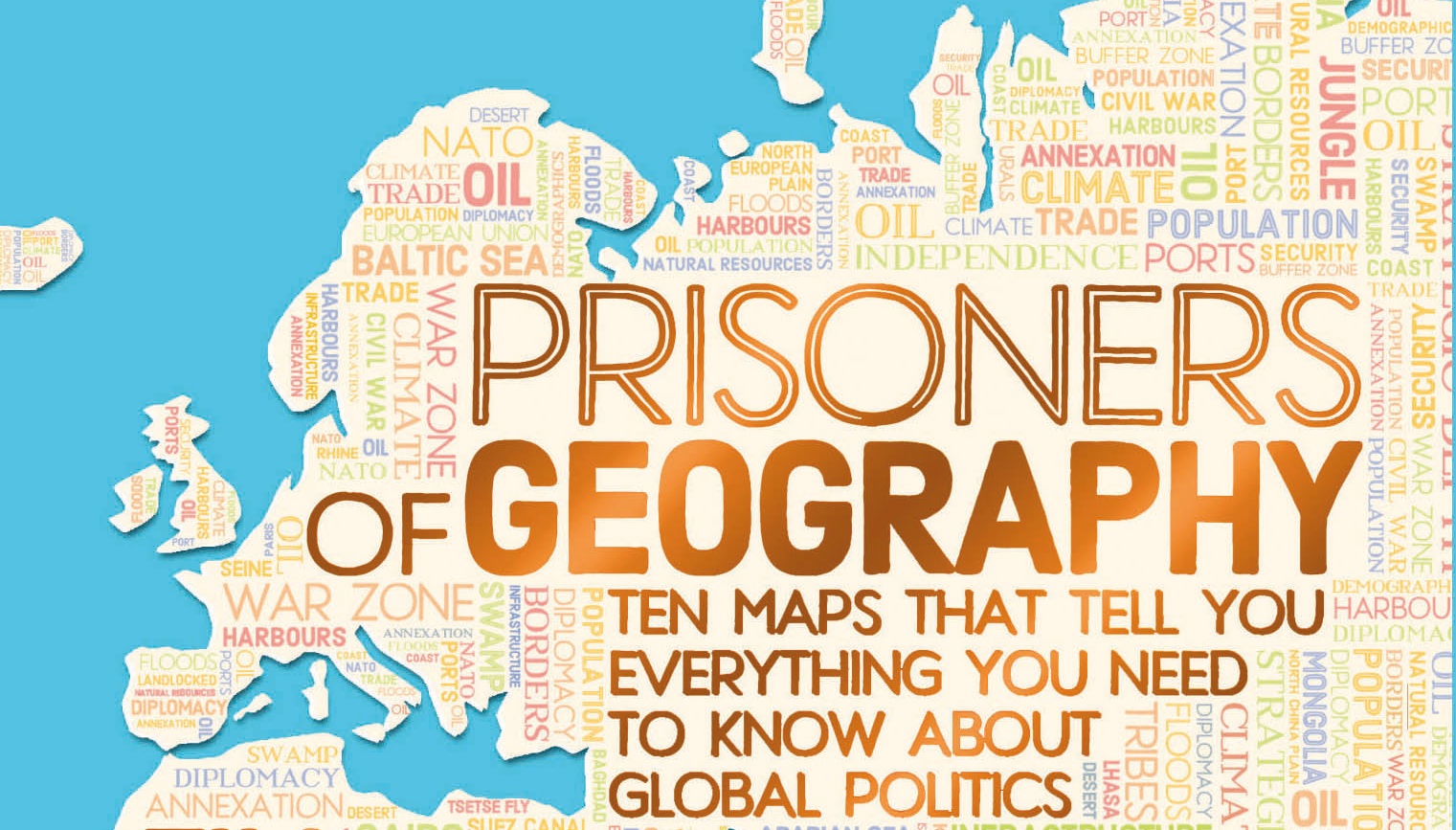
Subtitled ‘Ten maps that tell you everything you need to know about global politics’, Prisoners of Geography was first published in 2015 and reissued in 2025 in a new edition. What I have in my hands is the 2015 edition, as this is what my father enthused about on my last visit. I was – pleasantly – surprised to hear him speak of the mess European colonial powers had made in drawing arbitrary lines on maps, so I decided to give the book a go.
It is certainly a page turner and an engaging, accessible on politics and history. It is authored by Tim Marshall, a broadcaster and journalist most known for his career with Sky News, who has also contributed to the BBC and LBC. If your interests intersect with history, geopolitics, sociography or current affairs, and you are not yourself an expert in any of these fields, this book will be of interest. It is a New York Times and Sunday Times bestseller, and on flying back home after visiting my parents I spotted the new edition in the top ten racks of the airport book shop. It is clearly still selling well.
Reading the 2015 edition highlights one problem with books like this: history is an ongoing process, Fukuyama’s once feted ‘end of history’ thesis is a dented sign lying by the side of crossroads long since passed, and life comes at you fast. Since the book’s first edition the world has seen the effective annihilation of ISIS/ISIL/Daesh; the Russian invasion of Ukraine and subsequent deadlock; the expansion of NATO and unexpected internal threats to its foundations from, uh, the alliance’s sponsor; an increasingly belligerent Israel in the Middle East and a bloodthirsty domestic attitude toward war and punishment at odds with shifting international perceptions; the steady erosion of the international rules-based order; the collapse of the Syrian state and the accession of former jihadis to power; a shift away from globalisation alongside the accelerated decay of American soft power and an internal assault on its state capacity and liberal institutions; an increasingly dismal civil war in Sudan; and so on. Some of the statements and arguments put forth in Prisoners of Geography hold fast, whilst others are dated, almost tragi-comically so. Such is the fate of books that speak to the present moment.
I am mightily curious as to what has changed in the 2025 edition. I have to assume it was written before Trump took office for the second time.
A more reasonable criticism is that Prisoners of Geography‘s unique selling point is a hook on which to hang a series of international regional and geopolitical primers. In places geography clearly has an outsized impact on political options and choices across long spans of time. Wide, flat and open plains being difficult to defend against land invasion, for example, or where impassable mountain ranges historically prevent warfare and border friction, or the way different biomes and terrain can impact economic development. Yet that subtitle, ‘ten maps that tell you everything you need to know about global politics’, is never really true. The maps are interesting, but they are window dressing as Marshall describes the various factors he sees in play: sometimes geographic but also variously sociographic, ethnographic and religiographic where it concerns populations, and as frequently conflict between regional or great powers. Geography alone is not determinative, and the maps convey just a fraction of what Marshall describes.
Even so Prisoners of Geography is at its best when it cleaves close to its marketing gimmick, both when it covers something entirely new to you, or that connects with existing knowledge in provocative ways. For me, the former included reading how the Grand Escarpment – vast cliffs that dominate much of the Brazilian coast – and lack of river access impacted Brazilian trade infrastructure and economic growth; the latter, connecting the widening funnel of the North European Plain to the long history of warfare tracking east and west across Europe and Russia. Elsewhere, where the geographic material is more dilute, chapters stray into digressions on how many fighter craft are stationed here or there, or – repeatedly – the infrastructural investments of the perfidious Chinese!
I jest, slightly. You will however find many, many references to such Chinese state investments, alongside precisely zero to the International Monetary Fund and its track record on similar initiatives, and are thus left with no inconvenient questions as to why some poorer nations may find Chinese infrastructural investment appealing when compared to that track record.
So, the author is very much still alive and Marshall’s political perspective naturally permeates the book. He is even-handed on many points and as mentioned does acknowledge the historic violence and long-term impact of settler-colonialism in many parts of the world, the colossal incompetence and negligence of the partition of India, and the disastrous drawing of lines on maps by the arrogant and the ignorant, and so on. This is no exercise in cheerleading for the glorious history of the Western way of life. All the same you may, depending on your own prior knowledge, observe absences you find curious. For me the most glaring example was in the words “The British came, and went”, which is all you get on what the British East India Company was up to between the early 18th century and the mid 19th, and the British Raj for the following century.
I found more irritating the almost fatalistic description of religious and tribal divisions in the chapters on the Middle East and the Indian subcontinent, as if these could never be bridged. It is true that in many regions they have not, and this book is not alternate-history fiction. Yet Marshall chooses not to mention – and these are top of mind examples from someone who just reads stuff for fun; my knowledge is lumpy and uneven – historically recent pan-Arabist and anti-imperialist political ideologies like Nasserism, which one way or another at least engaged with the realities of post-colonial experience, or the religious tolerance of historic entities like the Ottoman empire. Of course one cannot include everything in a book, but I would happily drop a few references to how many fighter jets this or that state has stationed here or there in order to accommodate a little more history and a little more politics, and by the way in the chapter on South America we do get a very brief description of Bolivarian revolutionary ideology. So, what the book chooses to mention, or not, can be uneven, and it is obviously written from an Anglocentric and mainstream perspective. I know; you are shocked.
Still. I am no more a historian than Marshall is, and I am certainly no journalist. I am, in the democratising traditions of the old world wide web, just some dickhead with a website and a pocketful of opinions. I have spent a majority of my words today finding fault with the book, but in truth the process of exploring fault and difference was my more active engagement with a book I otherwise simply enjoyed and found informative. Criticisms aside, Prisoners of Geography was a good read. It taught me a few new things and that is always welcome.
