


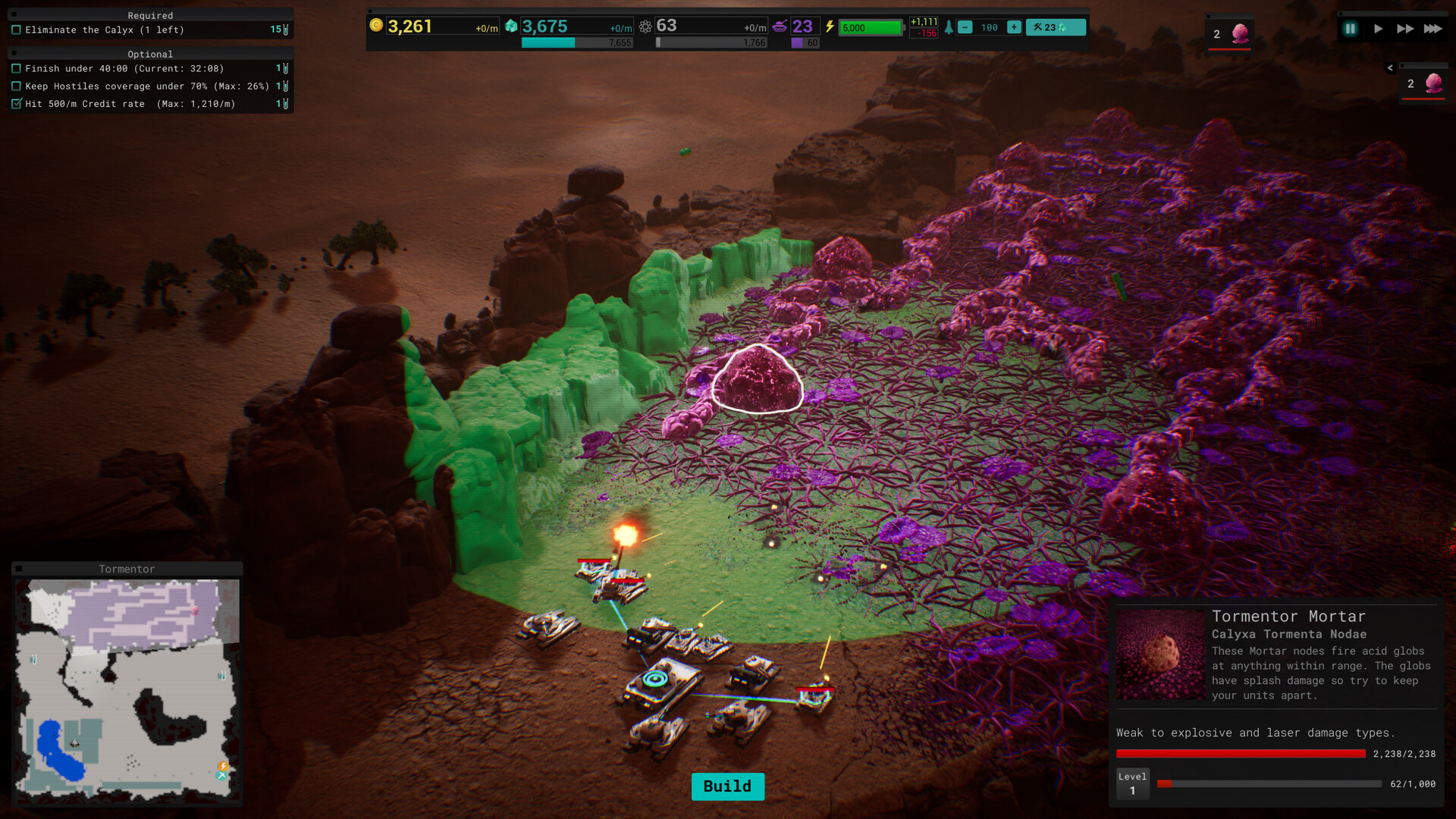
Calyx – the name comes from the Greek term for a husk or seed pod – is a real-time strategy game where the twist is that you’re not fighting against a mirror of yourself, constructing sprawling bases and churning out deathblobs of units to smash together, nor even fighting asymmetric opponents with different types of units and abilities, but rather you are fighting the creeping growth of plant life that spreads out across the map.
Naturally, given that it is the year 2026 and all humanity’s sins are brazenly on display, our species is not covering itself in glory here. The plot is fun: in essence, a slower than light starship with its crew in stasis has reached its destination, and most of the ship and crew are pretty fucked, thanks for asking. The one survivor is the chef, who the ship’s AI immediately rockets down toward the planet to start beginning mining operations. Because why else would anyone travel, really, other than to gather delicious, colourful mineral ore?
The game itself feels a little bare-bones in places, at least in the demo; the full version is available to buy and play already. It is an early access title and the small team behind the game estimates another 6-12 months to finish it. My money is on a full release in 2027, but we’ll see! Anyway, I say bare-bones as the UI is serviceable but rough in places, the maps are fairly small, the pool of AI opponents does not look vast (though I’m sure at least some do not appear in the demo), and your own range of units and defenses is quite slim and comprises the kind of RTS archetypes most people reading this are likely familiar with. Light scout, medium tank, artillery, repair unit, artillery unit, very large tank, and flame tank. There is also a big and slow laser-toting vehicle that is the best for dealing with hard targets. Hard as in fibrous plant matter, of course.
Speaking of plants, the variants I saw in the demo included a training-wheels plant that just grows but is otherwise passive, a tougher variant that will attack units that are near its creep, one that grew mobile units to attack the player’s base, and one ‘bastion’ plant that grew no creep but did spawn smaller versions of itself. This last enemy was the hardest to take out, as it had high HP and had several ranged attacks to fight back with, that took a toll on my units. There are more — I’ve seen them in screengrabs and skirmish map previews — but these are the ones I encountered.
I had fun with the demo’s campaign missions and I played every skirmish map too. There’s replayability here with random seeds, probably mapped to which AI plant enemies appear where. I did find the game quite easy, and that remained true even after bumping the skirmish maps to Hard. I’ll try Impossible next, and I suspect it won’t live up to the name. I’m not sure if I am finding the game easy because I have played so many survival RTS games – They Are Billions, Age of Darkness, Diplomacy is Not an Option, From Glory to Goo – and I know the drill. You expand aggressively and early until you meet serious resistance, you push your economy very hard, you find choke points and you fortify there.
Calyx is much easier than the other games I mentioned in its skirmish mode because the entire map is clear except for where the plants start. (For whatever reason, the full map is also visible throughout games, which makes the player’s life much easier. I guess the ship has good visibility from orbit.) Thus you can quickly judge where you can likely secure before the plants get there. Locking down positions is also not hard provided you pushed your economy hard enough to build a decent number of turrets, supply the power to keep them running, and access the buildings and upgrades that give you better turrets. From that point onward, although the plants level up and grow stronger, I never had any serious issues with them breaching my base, so the challenge simply became building up enough units to start pushing the creep back until I could reach the origin point and kill the plant.
There’s a lot I like about this game. I like the way it realises the way a lot of these games play – defending against swarms, securing map control – with an opponent that literally, persistently and without pause tries to colonise every speck of the map. I like the way that destroying a root causes all downstream foliage to die off rapidly (unless anchored with a subordinate plant growth). I like that the range of units and turrets available at present all have clear utility, and against the toughest enemies you will need to bring a little of everything. I like the lighthearted and silly story to justify all this. I like that the setting basically involves humanity falling back on rapacious resource extraction as default instruction and setting up as antagonists plants that are just doing what they do, on the planet they live on.
I do have reservations about how easy I already found the game, and whether that is a soluble problem as the game develops, or if it is innate to how the core concept functions. I can imagine more open maps would be a nightmare, for example, as all my successful plays were about utilising clear chokepoints. The campaign missions also don’t play out like skirmishes, with planet growth already established, so I hope those missions will involve a variety of interesting challenges. So, I will be following the game’s development with interest to see if these concerns are addressed, and I look forward to playing more closer to 1.0 release.
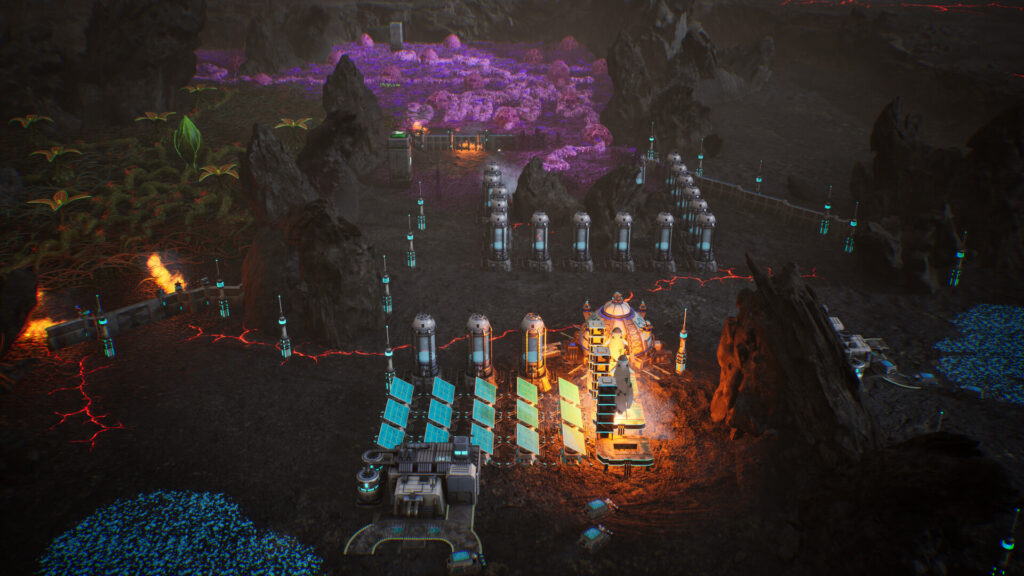
UPDATE: I went back and played the largest map on Impossible difficulty, and it was considerably harder! The damage debuffs on your units are considerable, so progress was much more gradual (and satisfying).
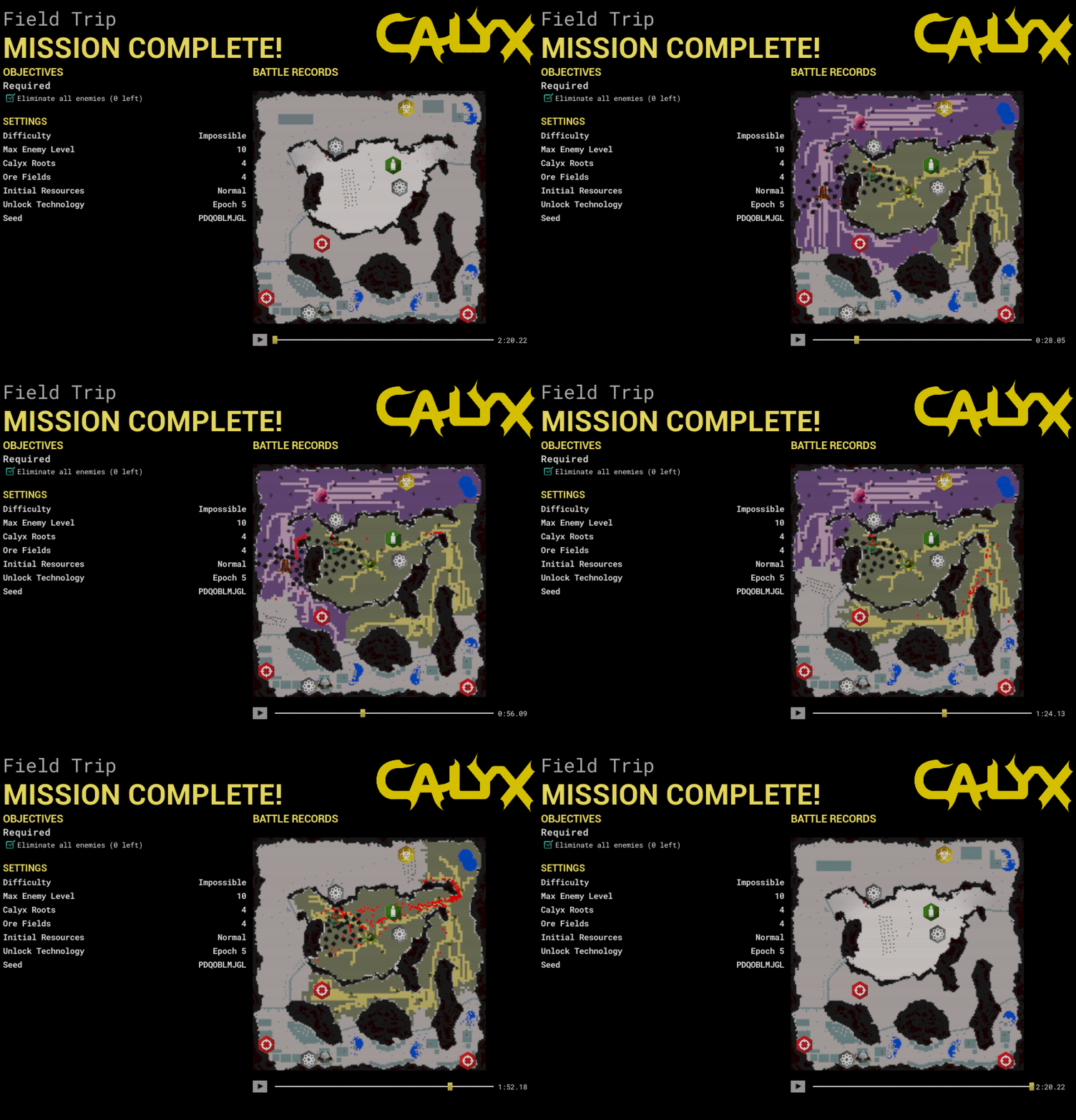
I also noticed that the game lets you export gifs of your timelapse minimap at the end of a mission, so here’s me taking over two hours to clear. You can see I grab a lot of mineral deposits very quickly, then sit behind my defences while I build units. Then once I venture out, it takes me forever to progress! In hindsight, I should have been more aggressive in my land-grab and tried to lock off and hold slightly fewer chokepoints, which would have resulted in fewer problems trying to secure the flanks on my push.

2 comments
Pretty much a review, great first impressions! I’m thankful for the comparison to They are Billions, Age of Darkness and so on, that’s the angle I want to play the game from. And it’s unfortunate that apparently the game is pretty easy if you’re experienced with those other Survival RTS, which I am (I’m not great at them, but I’ve played a lot).
But it still seems like a very decent game in that genre, so I’m curious to try it out.
I’ll definitely check out the game at some point, maybe at 1.0 release or on a sale.
Thanks for commenting and glad you found this write-up interesting!