

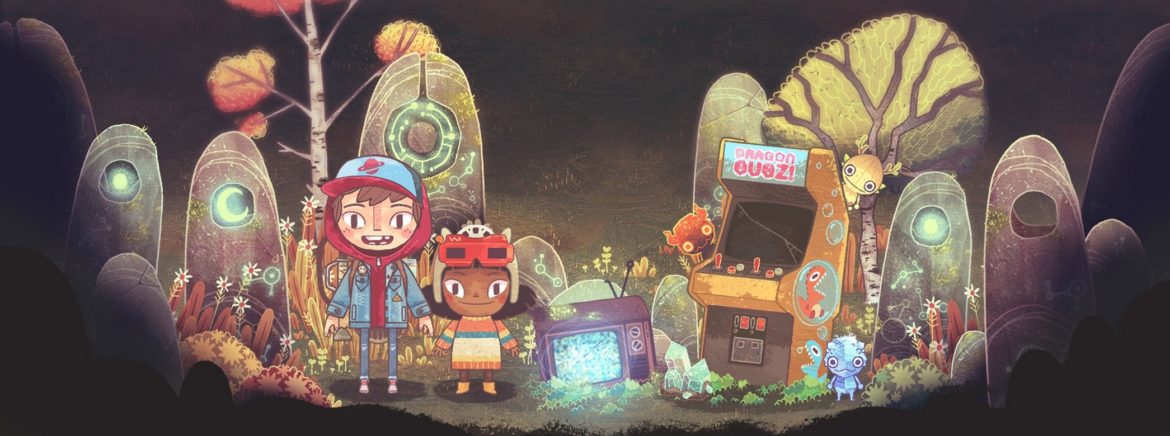
The Wild at Heart opens with scenes that suggest trauma and broken homes. Its protagonist, Wake, has lost his mother and is running away from a spectral father figure slumped in front of the TV and surrounded by beer bottles. You’ll read from that what you will. His younger friend Kirby has a neglectful single parent, although we see nothing of her home life. The two friends have agreed to run away together and live in the nearby woods. Things immediately diverge from that plan as the guardians of the Deep Woods draw Wake into their world. Kirby, somehow, soon follows, and the two friends meet up not long into the game.
The game’s developers recognise that comparisons with Nintendo’s Pikmin series are inevitable and they acknowledge the relationship. It’s a comparison that it’s senseless to try and avoid because there is much here that can be traced back to Miyamoto’s cult classic series, and talking about The Wild at Heart is aided by using Pikmin as a reference point. I’m getting this out of the way now, because from here I am going to casually reference Pikmin staples – if you lack familiarity with that series you will be just fine reading this, and also you should play Pikmin – and this will help in highlighting where The Wild at Heart champions its own voice, style and mechanics.